October 12, 2008

About Contributor Stephan Spencer

Number of posts contributed
55
Website
Stephan Spencer's Scatterings
Email
Email Stephan
AIM
StephanSp
Profile
Stephan Spencer is Founder and President of Netconcepts (http://www.netconcepts.com), an 11 year-old multinational web agency specializing in search engine optimization, e-commerce, web application development, website auditing, email marketing and blog strategies. Clients include Verizon, REI, AOL, Kohl's, Home Shopping Network and InfoSpace, among others. Stephan is a sought-after speaker, presenting globally, and is a contributing writer to publications such as DM News, Multichannel Merchant, Catalog Age, Practical Ecommerce, Unlimited, and NZ Marketing magazine. He is a Senior Contributor for MarketingProfs.com and co-author of the analyst report "The State of Search Engine Marketing 1.0" published by Multichannel Merchant. In his "spare time" Stephan blogs at StephanSpencer.com and NaturalSearchBlog.com.

Posts by Stephan:

How Interactive is Your Blog? Measure It!

Posted by: Stephan Spencer of Stephan Spencer's Scatterings on on 08/25/08

One of the coolest things about business blogging is the social interaction and community that is built when readers leave meaningful comments. Like a good story, a post elicits a response from the reader. As your community develops, the value of your brand increases. But this warm and fuzzy feeling that people get about your brand as they interact with you on your blog can be hard to measure and quantify. That’s where blog interaction metrics come in.

Building a blog to one or more interaction metrics can help you focus on what’s important - brand engagement.

Do you measure a successful post by the number of readers, bookmarks added to del.ic.ious, diggs, comments, number or quality of backlinks, or a combination of all the above? Some metrics have a place in your blog marketing scorecard, like number of comments. And some do not, like number of trackbacks (unless you like counting spammers — and that you could do all day!). Because the last thing you need is just more data for the sake of data.

Avinash Kaushik came up with some really nifty blog success metrics that really resonate with me. I bet they’ll resonate with you too. They are:

  • Raw author contribution (posts per month and words per post)
  • Audience growth (onsite & offsite, visitors and unique visitors)
  • “Conversion” rate (comments per post)
  • Citations (blog inlinks, Technorati rank)
  • Ripple Index (# of unique blogs linking to your blog)
  • Cost (time, hardware/software technology, opportunity cost
  • Benefit / ROI (comparative vs. direct vs. “non-traditional” vs. unquantifiable)

As you start measuring the above and then gauging the success of what you’re doing on your blog based on these metrics, you can tie your activities back to something more meaningful than just the “hits” you’re generating.

If you want to learn more about metrics, I encourage you to watch the archived recording of a “Website Metrics and ROI” webinar that Avinash and I presented last year. No registration required. Just click and watch (or download). It’s 100 minutes of the two of us talking about our favorite metrics — not just for blogging, but also email marketing, web marketing, search marketing, and more. And if you just want to scan over our Powerpoint slides before you invest 100 minutes of your time (and I don’t blame you — time is precious!), here’s the PPT file. Enjoy!

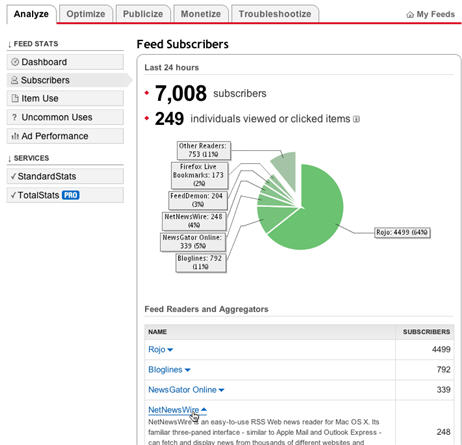
FeedBurner Blog Metrics

What blog metrics do you value most? How do your readers interact with you? Do you have any particular reporting tools you recommend? Your interactivity is welcome and invited.

Sun CEO on Communication through Blogging

Posted by: Stephan Spencer of Stephan Spencer's Scatterings on on 05/16/08

Sun Microsystems CEO Jonathan Schwartz gave a great keynote interview at the Web 2.0 Expo last month. He was interviewed by Tim O’Reilly. The 30 minute-plus interview covered a wide range of fascinating business- and technology-related topics, not the least of which was business blogging. The first five minutes after the introduction concentrate specifically on how Schwartz — whom O’Reilly called “One of the most senior bloggers around” in terms of business leadership — uses his blog to reach both employees and potential clients.

Jonathan Schwartz accepts blogging wholeheartedly, but rejects the word itself. “‘Blogging’ will at some point be a little anachronistic. I communicate. My number one job as a leader of a company is to communicate. You used to communicate by being the celebrity CEO, you flew around and spoke with heads of state, and got local media to cover it, and got your message out in an inefficient and environmentally irresponsible way. Then the Internet came along and gave you access to the whole planet all at the same time. So why not use the Internet as a way to communicate directly and authentically to the marketplace? Then I will have satisfied at least one portion of my job.”

Blogging doesn’t just communicate with the marketplace, though. Sun’s CEO also uses his company blog to communicate with the more than 32,000 Sun employees. When they have questions about business decisions, Jonathan can respond to both the company and the marketplace via his blog. “If you are going to lead, you must communicate,” he said in the interview. “You can communicate in many different ways, through your actions, through your products. The way I communicate is by using the spoken and written word.”

Schwartz is a genuine blogger — he’s very much against having the PR people do any writing for him. But do they mind that they’re not in control of his message? “I don’t think I’ve ever terrified our PR department, but I’ve terrified our securities department once or twice, and they’ve been very quick about telling me to put in a safe harbor statement at the beginning of the post, and then they make an SEC filing based on what I just said, but now we’re very practiced about this and that’s no longer the norm. I can get away with a link to a safe harbor statement now.”

The CEO isn’t the only blogger at Sun — more than 4300 people at the company, from marketing and HR staffers to high-level engineers and managers have blogs on the Sun Microsystems corporate site. Some of them are in languages other than English, and many of them are fascinating not solely as an insight into the internals of one of information technology’s founding companies, but as a collection of smart people who love to share ideas about a wide range of subjects. “The most terrifying day for me as a blogger was when our general counsel started writing a blog,” Schwartz said jokingly. “Actually that’s not true — he’s very thoughtful. And guess who reads his blog? Other general counsels.”

The rest of the interview covers Sun’s MySQL purchase and the integration of two businesses into one, Sun’s open source strategy, cloud computing, how giving away products for free gives insight into the market and access to potential hardware and services customers, utility computing, the evolution of high-performance computing, the “black box” data center, efficiency and power consumption (”[electricity] is the number two expense, next to people”), and how blogging helps inform people about all of these issues.

Good stuff!

If you’re a CEO, you’d do well to emulate Jonathan’s approach to business blogging.

Brand Yourself on Your Blog, in Your Feed, with a Photo and Sig Line

Posted by: Stephan Spencer of Stephan Spencer's Scatterings on on 05/15/08

In my blog post about the importance of your avatar in social media marketing, I included my headshot photo to show folks what I use as my avatar on social media sites:

Stephan Spencer avatar

Seeing this in my post gave one of my readers, Dave Dugdale, the idea to append his photo to the end of posts on his blog’s RSS feed. That is a great idea. That headshot image of me appears only in my aforementioned post because I added it by hand. It certainly wouldn’t be hard to automate it so that your image (and byline, and links) would appear on ALL your posts. Then, folks using RSS readers and website aggregators like Bloglines and Google Reader will see this photo and byline while reading your post, helping brand you and letting people know who you are. You, as the author, will appear more real, more tangible, more human, to the reader. S/he will relate to you more as a fellow human being, take notice of you, remember you, and listen to what you have to say. S/he may even then recognize you at conferences and introduce herself/himself to you (this has happened to me on many occasions!).

Another important benefit of this tactic is that it somewhat thwarts content thieves who “repurpose” your blog post content on their blogs. If they are scraping from your RSS feed, they will be putting up your photo, byline, and links on all the posts they stole from you! (By the way, if they are scraping your HTML — which won’t be nearly as common — then the photo and byline would need to appear on your blog site, not just your feed.)

So how do you accomplish this — putting a sig line containing your image/avatar on all your posts? You could add the sig line to your template (theme) files. But there are other, easier ways. For instance, if you’re running WordPress, there’s the RSS Footer plugin or the WP-Avatar plugin.

Or, if you’re using the excellent Feedburner service for your RSS feed, there’s the “Feed Image Burner” tool.

You can also put a tiny image of yourself into your blog’s favicon too, which will cause it to show up next to your blog’s name on many RSS readers. That’s what I’ve done on my blog. Here’s what it looks like: favicon

If you don’t have a custom favicon, don’t know how to create one, or don’t know what I’m talking about, then you should read my post Favicon and Robots.txt – Must-Haves for your Blog.

Secrets to a Faux Blogger’s Success: Fake Steve Jobs

Posted by: Stephan Spencer of Stephan Spencer's Scatterings on on 04/29/08

Usually faux blogs get lambasted on the blogosphere for violating the unwritten business blogging rules of transparency, openness, and authenticity. (Remember Raging Cow?) Not so with “Fake Steve Jobs,” aka Forbes columnist Daniel Lyons, who gave a hilarious speech at the Web 2.0 Expo last Friday. The 25-minute video is embedded below:

Lyons’ main points about his successful blog are:

  • It’s material he’s excited about
  • He has fun writing on FSJ
  • He embraces audience participation
  • The mystique behind FSJ’s identity helped build the blog’s readership

Lyons covers three “Whys” behind the Fake Steve Jobs blog: why he got into blogging (fear and boredom), why he chose Steve Jobs (he’s narcissistic, Apple has bad PR, and Apple fans tend to be so, well, fanatic), and why it works (it’s the audience!). When he first learned of successful business blogs like Jonathan Schwartz’ at Sun Microsystems, Lyons thought it was a great idea. But what if one of those blogging CEOs went crazy and posted all kinds of un-photogenic, not-approved-by-PR material? Thus Fake Steve was born, and readers found it interesting. He had 90,000 monthly readers within 6 months of launch.

“I think what’s happening in media is profound and interesting. This thing [Fake Steve Jobs] is all very wrong, obviously very stupid and primitive, right? But it’s a great way to learn about how new media might work. I think the biggest change we’re going to have is the involvement of the audience. Where Internet media is going to get interesting is when we start really exploiting the uniqueness in it rather than paving a cowpath. First generation Forbes.com was, take the print magazine and put it online. Hulu was take TV shows and put them online. But when we start involving the audience, and having people form a group to entertain themselves, I think that’s going to get really interesting.”

Passion’s the key ingredient in successful blogging

Posted by: Stephan Spencer of Stephan Spencer's Scatterings on on 04/17/08

Not getting as much marketing power out of your blog as you’d hoped? The rules for successful blogging are the same whether you’re writing for personal or business reasons. First of all, you have to write about what you love or what you’re passionate about. When you write about what you are passionate about, readers will feel it too, and the entire process of writing will be more enjoyable as well. If you’re running out of topics or your blogging feels like a chore, then you should find a new angle on your work — one that you’re passionate about. Hopefully you love your work and your job, so it shouldn’t be too difficult to find things that are fun to write about, but sometimes it’s better that you concentrate on a specific aspect of your work that you’re particularly interested in.

If you have no passion for what you are writing about, why are you writing at all? Your entries will come across as boring or flat and you will not gain the readership your writing skills deserve. When you write about what you love, it is a lot easier to sound like an expert in your field. If you are not sure what you are passionate about, take the time to figure it out. You owe it to yourself, and your potential readers, to know and write about what makes you get out of bed in the morning. If your goal is to make money with a blog, write about what you love and the money (or sales) will follow… You will have more readers and will write better posts. Great content brings traffic/conversions and when you write about something you love it is difficult to write poorly.

What’s it like to read your favorite blogs? I’d have to say my all-time favorite blogger from a writing perspective is Fake Steve Jobs. Sure, he’s not even real, but he “keeps it real.” Every post is witty, and I love his creative use of language and his invented words (e.g. MicroTards, Freetards). The blog provides a little window into Steve Jobs’ psyche. Well okay, maybe not, since it’s actually being written by a Forbes magazine journo, but wouldn’t it be cool if it were the real Steve Jobs?

FSJ may not be the real Apple CEO, but Jonathan Schwartz definitely is the real CEO of Sun Microsystems, and his blog is an excellent example of great blogging. Jonathan posts about Sun projects that he finds exciting, and technology trends that he has an interest in. As a top-level industry insider, Jonathan makes you feel like you’re getting a unique perspective on information technology.

In the past I’ve held up science teacher Steve Spangler’s blog as an excellent example of business blogging, as well. Steve’s blog helps establish his expertise and showcase his brilliance, which keeps him busy in his various adventures. If you like science and haven’t visited Steve’s site yet, you’re missing out.

What are some of your favorite examples of passionate business or marketing blogs?

Need More Time to Blog? Here’s Your Answer!

Posted by: Stephan Spencer of Stephan Spencer's Scatterings on on 04/10/08

Do you ever feel like no matter how well you plan your day, you never seem to finish all of your scheduled tasks, including all the blogging you wanted to do? I know I do! There is an answer! …it’s “GTD” (Getting Things Done), a time management, or more appropriately, life management methodology developed by best-selling author David Allen. This methodology is outlined in great detail in one of my favorite books, Getting Things Done.

Recently I had the distinct pleasure of sitting down for a fascinating discussion with David Allen; that discussion is available for download as an MP3, or just hit the Play button below:

 
icon for podpress  Stephan Spencer interviews David Allen [46:36m]: Play Now | Play in Popup | Download (1343)

I’m a big fan of David’s, having attended one of his workshops in Chicago last year. I’ve written before about how GTD works, but this interview goes into some of the areas I struggle with the most. David gave me some excellent answers on how to…

  • eliminate time-stealing distractions,
  • how avoidance affects success,
  • how crisis negatively impacts your ability to think intelligently,
  • how sometimes waiting until the last minute is the best way to get things done,
  • the importance of emptying your email inbox,
  • the usefulness of virtual assistants,
  • and how the biggest barrier to self-expression and self-actualization is our own selves.
  • “You can’t manage time,” David said. “You actually only manage what you do during time. So the management issue is not so much about time, it’s more about how you manage your focus, how you manage your actions and your activities in terms of what you do. That’s one of the problems with that whole field of time management — they mislabel the problem. Because they label the problem as time, everyone thinks that the calendar is going to be your solution, and it isn’t.”

    In a deadline-driven, time-sensitive, stress-filled world, having the right strategies to deal with your blogging and all your other responsibilities is essential to avoiding burnout and remaining permanently productive. With some elements of your professional life, David’s advice is simple to apply, such as merely paying attention to what has your attention. With other things, you may find yourself facing off against tightly-held, self-destructive habits and behaviors that will prove difficult to disown.

Upcoming Blogger Conferences

Posted by: Stephan Spencer of Stephan Spencer's Scatterings on on 03/18/08

WordCamp Dallas is later this month — March 29-30. Netconcepts’ own Chris Smith will be speaking on SEO for blogs. There’s a great lineup of speakers, including WordPress founder Matt Mullenweg. Registration is only $20. There’s no reason not to attend! Even if you blog on a different blog platform, you should still attend. The networking with fellow bloggers alone is worth the travel costs. I speak from experience, having attended WordCamp in San Francisco last summer and I loved it.

Blog World Expo is another fabulous conference to attend. Their inaugural year was last year. It took place in Las Vegas and will be back in Vegas this year — September 20-21. At last year’s conference I spoke on an SEO panel with SEO gurus Aaron Wall, Andy Beal and Vanessa Fox. I stayed to the very end of the conference, and I was glad I did. I got to hear billionaire blogger Mark Cuban speak during the closing keynote of the conference.

Then there’s BlogHer 2008 — a conference for and about women bloggers, taking place July 18-20 in San Francisco. All the speakers are women. My 16-year-old daughter Chloe Spencer (the Neopets blogger) was privileged to speak on their Professional Blogging panel at BlogHer 2007. I attended last summer and really enjoyed it, even though I wasn’t the main intended audience (i.e. women bloggers).

One guy I spoke to during a cocktail reception at BlogHer last year told me that BlogHer was a great conference for single men like him to attend. He said it was “like shooting fish in a barrel.” Haha, I laughed when I heard him say that. Contrast that with WordCamp Dallas, which is projected to be 75% male.

Any other conferences for bloggers out there that I’ve missed?

Is Your Monitor Size Holding You Back?

Posted by: Stephan Spencer of Stephan Spencer's Scatterings on on 03/18/08

Bloggers are information workers. And information workers need a big screen monitor — and/or multiple monitors — to be optimally productive. The Wall Street Journal blog recently posted about a study by the University of Utah that found that folks using a 24-inch screen completed tasks 52% faster than those with an 18-inch screen. And folks using two 20-inch screens completed tasks 44% faster than those with an 18-inch screen. So size (and quantity) really does matter. This conclusion was affirmed by most of the commenters to that WSJ post.

So… what monitor size are you blogging with? And are you using two monitors, or just one? That one single small monitor you’re using for blogging is holding you back!

According to a Google employee who commented, Google engineers get to choose between a single 30-inch HP LCD or two 24-inch monitors, and employees in other departments get one 24-inch.

My office setup is 3 screens — my MacBook Pro laptop screen which is 15-inch, a secondary, 17-inch monitor plugged into my laptop, and an iMac with a 17-inch built-in display. The iMac and my MacBook Pro are set up to both use the same keyboard and mouse. To accomplish this, I use a free software program called Synergy. It is amazing! I can move my cursor across the three screens with one long swipe of my mouse. I can copy text on my iMac and paste it onto my laptop, and vice versa.

When I went from one screen to three screens, I definitely saw a productivity benefit across many activities, including email, blogging, article writing, and Powerpoint creation. Right now as I write this post, I have the “Write Post” screen on one display and the Wall Street Journal post open on another display. It makes it so much easier when I want to quote or reference bits from the WSJ.

Another interesting point that another commenter to the WSJ post made was that monitor size was a criterion he used in evaluating potential employers. He called it an “environment factor.” That was really good insight. We at Netconcepts are in the process of trying to fill 11 open positions. Seeing workstations configured with awesome monitors could very well influence a candidate’s decision to come work at Netconcepts.

Bloggers, What’s Your Hook?

Posted by: Stephan Spencer of Stephan Spencer's Scatterings on on 03/5/08

Whether you’re just starting out in the blogosphere or you write for an established blog, you’ll need an angle to set your blog apart from the rest. Ideally, this theme will carry through all your posts, injecting the blog with a unique style and personality (e.g. snarky, witty, professorial, egotistical to the point of humorous, self-deprecating, nihilistic, voyeuristic). Your angle could also be in the way you present your content, too. For example, you might offer video blog posts that are extreme close-ups or you might include hand-drawn illustrations with your posts.

An angle helps make your blog remarkable, which is a laudable goal for any marketer. In his book “Purple Cow,” marketing guru Seth Godin stated that being “remarkable” doesn’t mean you (or your blog) needs to be the best, it means that you need to “be worth remarking about.” Seth also said that the opposite of “remarkable” is “very good.” In other words, having a “very good” blog just doesn’t cut it — not when there are hundreds of millions of other blogs out there too.

Another way of thinking about a “hook” or an “angle” is to think about your blog as “link bait.” Link bait is content that is so funny, so interesting, and so useful that it becomes irresistible to other bloggers and site owners to link to and “remark” on. Nick Wilson revealed 5 “hooks” in his landmark post on link baiting:

  1. humor hook
  2. news hook
  3. contrarian hook
  4. resource hook, and
  5. attack hook

Link bait can take the form of Top 10 lists, humorous videos uploaded to YouTube, checklists, cartoons, tools, widgets and blog plugins — to name a few.

One business blog that I think really nailed this concept is Sparkle Like the Stars, a blog owned by jewelry retailer ice.com. The blog is snarky, irreverent, fun, voyeuristic, trendy and useful — all at the same time! This blog’s hook is paying off, in the form of a loyal following.

We, at Netconcepts, decided to follow in the footsteps of Sparkle Like the Stars to create a blog about shoes we affectionately named, “The Shoe Paparazzi.” The idea behind it was to fuse footwear with the “sport” of celebrity watching in order to capture and keep readers’ interest. At this point it’s still just an experiment, a pet project of Netconcepts that wasn’t commissioned by a client, but is something we hope can be used in the future to prove the case for the “celebrity watching hook” as a viable angle for online retailers.

As far as blogs go, I’m not 100% certain we’ve hit that right hook/angle yet to build that loyal following every blogger dreams of. I put it to you, my fellow bloggers, do you think our Shoe Paparazzi experiment is link-worthy? What’s your blog’s hook, and how’s that working out for you? Talk back via comments.


Blog carnivals - a link building secret weapon

Posted by: Stephan Spencer of Stephan Spencer's Scatterings on on 02/27/08

One thing which has been alluded to briefly here on BusinessBlogConsulting.com in a couple previous posts is blog carnivals — a relatively untapped opportunity for blog marketing and link building.

It was fellow Business Blog Consulting contributor Toby Bloomberg who first turned me on to blog carnivals. For those who aren’t aware of what a blog carnival is, it is a traveling column on a particular subject matter that is passed on from blog to blog, each blogger selecting a topic in that subject matter and including relevant resources accompanied by their own commentary about those resources. For example, there might be a blog carnival on nonprofit marketing and indeed there is. The members of the blog carnival rotate in and out, kind of like a column rotates. Here is an example post from a nonprofit marketing blog carnival.

Why should you care about blog carnivals? In short, because it’s a great way to grow your link popularity and thus your search rankings, and because it’ll also gain you visibility in the blogosphere amongst bloggers. This can be accomplished in two ways:

  1. First, by hosting a blog carnival, you garner links you wouldn’t otherwise have garnered from the other blog carnival hosts as well as other bloggers who follow that blog carnival (assuming of course your posts are of some value!).
  2. Second, even if you don’t join a blog carnival, you can submit your own posts to the current host for consideration in the next carnival post. For instance, in the example carnival post above on nonprofit marketing (which focused on “Creating and developing online communities through Web 2.0″), imagine if you had written a post on “How Nonprofits Can Use MySpace” and then gotten that post included in that week’s edition of the carnival — and all it would have taken is reaching out to the host via email to get on their radar.

Check out BlogCarnival.com, a directory of blog carnivals, to see if a blog carnival already exists for your industry or topic of interest.

Shorten Your Blog Post URLs So You Don’t Look Spammy to Google

Posted by: Stephan Spencer of Stephan Spencer's Scatterings on on 01/3/08

One of the great things about using WordPress is that it automatically creates keyword-rich, spider-friendly URLs for your posts (as long as your Permalink settings in the Options tab of the WordPress admin are configured properly). Many times, though, these URLs are TOO keyword-rich. In other words, the URL has too many words in it. That happens if you create a long title to your post, because every word in the title is worked into the URL automatically by WordPress.

But how long is “too long” for a URL? For the answer to this question, I went to the source: Matt Cutts, head of Google’s webspam team. In my interview with Matt Cutts, I asked:

“What is excessive in the length of a keyword-rich URL? We have seen clients use keyword URLs that have 10 to 15 words strung together with hyphens; or blogs - we have seen them even longer there. A typical WordPress blog will use the title of the post as the post slug, unless you defined something different and you can just go on and on and on. Can you give any guidelines or recommendations in that regard?”

Matt answered:

“Certainly. If you can make your title four- or five-words long - and it is pretty natural. If you have got a three, four or five words in your URL, that can be perfectly normal. As it gets a little longer, then it starts to look a little worse. Now, our algorithms typically will just weight those words less and just not give you as much credit.

The thing to be aware of is, ask yourself: “How does this look to a regular user?” - because if, at any time, somebody comes to your page or, maybe, a competitor does a search and finds 15 words all strung together like variants of the same word, then that does look like spam, and they often will send a spam report. Then somebody will go and check that out.

So, I would not make it a big habit of having tons and tons of words stuffed in there, because there are plenty of places on a page, where you can have relevant words and have them be helpful to users - and not have it come across as keyword stuffing.”

Based on this new information from Matt, you can see that even your blog post slugs have the potential to appear spammy and “keyword stuffed,” which doesn’t look great for your readers and may end up getting flagged as “spam.” So how can you prevent your blog from appearing spammy?

I’d strongly recommend that you curb the length of your URLs. There are a couple of different approaches to this in WordPress:

  1. Hand-craft your own “Post Slug” when you are writing the post. To do so, simply type in your desired post slug into the “Post Slug” field found on the right-hand side of the “Write Post” page in the WordPress admin (you probably will have to hit the + sign to see the field). You can mirror your post’s title but drop throwaway words like “the” and “and”. You can take the first four words or so of the title as your slug. Heck, you could even write something totally different that doesn’t resemble your post title.
  2. Use a WordPress plugin that will trim your post slugs down to a more manageable size, i.e. to five or six words. There are two plugins to choose from that will accomplish this: the WordPress Slug Trimmer plugin or the Automated SEO Friendly URL plugin.

For more great tips from Matt Cutts, I invite you to listen to my audio interview in MP3 format or read the full transcript. The interview is a little over 30 minutes long, and it has some invaluable advice.

Enjoy, and happy search engine optimized blogging!!!

Cirque du Soleil Does Killer Outreach to Bloggers

Posted by: Stephan Spencer of Stephan Spencer's Scatterings on on 12/17/07

Earlier this month I went to Las Vegas to attend (and speak at) PubCon, a conference renowned among search engine marketers. Many of my fellow SEO professionals in attendance were also bloggers. The organizers of Pubcon, including Brett Tabke and Joe Morin, had the foresight to offer the bloggers an irresistible offer, a “Bloggers Night Out“…

“So to put a twist on things, we are excited to announce that we have secured several hundred tickets to some of the best live theatre that Las Vegas has to offer. After years of having conferences in this town we’ve made a few friends and now these friends of ours at venues such as Blue Man Group, Cirque Du Soleil, MGM Grand, Treasure Island and The Wynn Las Vegas have graciously offered us tickets for our attendees in the hopes that they wouldn’t mind compiling a little review telling them what you think of their shows.”

KaI was really, really impressed with the generous offer. So I put my hand up. And I’m pleased to say that I was one of the lucky recipients to the Cirque du Soleil show called “Ka.” I’m a huge fan of Cirque du Soleil and had high expectations for this show. And boy it did not disappoint! I had a great seat and to take the show in. It was quite a different show from the ones I had seen in the past, such as La Nouba, Alegria, and Saltimbanco. It was a spectacle full of warriors swinging from ropes and jumping off balconies. They did the most amazing stunts on the stage as it rotated and tipped to the vertical.

It’s really forward-thinking on Cirque du Soleil’s part to agree to participate in something like this for Ka and for their other show, Mystere. Not only did I enjoy their show immensely, but I was clearly happy to blog about it to tell you what an amazing time I had (as you read in the paragraph above).

Now my challenge to you: can you emulate Cirque du Soleil’s marketing prowess by giving something of significant value away to bloggers? Reach out with this gift to bloggers in a positive, non-demanding way, and then get out of the way so those bloggers can spread the word about your quality service, product or, in this case, show.

Trick out your blog with a video Swicki

Posted by: Stephan Spencer of Stephan Spencer's Scatterings on on 10/25/07

You may have noticed (and hopefully used!) Eurekster’s Swicki widget on the right column sidebar of this blog (under the heaading labeled “Buzz Cloud”). A couple more examples of swickis can be found on my personal blog and on my daughter’s blog.

A swicki is a topically-focused custom search engine where you can define the topics and the sites that it focuses on.

My favorite feature of the swicki is the “What’s Hot” buzz cloud, which I’ve blogged about before. It’s a very cool feature that visually conveys popular search terms in a tag cloud format.

The swicki widget can do image-based buzzclouds too. So instead of displaying keywords, you (the blogger or website owner) can choose to display images instead.

This month Eurekster rolled out another major enhancement to their swicki widget: video-based buzzclouds! So now you can add to your blog a video buzzcloud widget with a custom social video search engine, which pulls from over 14 million hours of video content from blinkx.

See an example video buzz cloud on the right.

Sign up for a free swicki widget (text, image, or video) and build your free, Eurekster-powered custom social search engine here.

Will blog for steak!

Posted by: Stephan Spencer of Stephan Spencer's Scatterings on on 10/24/07

Ok, actually no I won’t blog for steak. I’m a vegetarian. But I bet plenty of other bloggers would take up such an offer.

Rajesh Setty emailed Chris Pirillo’s Braintrust list earlier this month with an email titled “Bloggers - free steaks anyone?” to promote the site AllAboutSteak.com and its sponsor Kansas City Steaks. In it, Raj wrote:

If you are a blogger and would be willing to provide some visibility - KCS wants to reward you with a gift packet (of steaks) sent to your address.

His email conjured up in my mind an image of a homeless blogger holding up a cardboard sign “Will blog for steak” — rather than the more typical “Will work for food”. (NOTE: This could make for an excellent Halloween costume for you unabashed nerds out there!)

But it also got me thinking about what is the right way to approach bloggers to get them to blog about your company/products or a client’s company/products. Something about Raj’s email got me feeling a bit uncomfortable. Thankfully though, Raj followed up later with a clarification email to the list, stating:

I should have said it better. If you receive a “gift” of steaks, all you are promising is that if you like the technology and/or steaks, you would consider providing some visibility to their “We Care” campaign.

I’m glad Raj followed up with that clarification. I think it’s critical when doing blog outreach that you don’t tie compensation to positive coverage.

WOMMA (Word of Mouth Marketing Association) developed a great set of guidelines — the Ethical Blogger Contact Guidelines, which provides some guidance around how to reach out to bloggers. Some good advice there!

So… will you blog for steak?

Extraordinary customer service inadvertently becomes blogger outreach

Posted by: Stephan Spencer of Stephan Spencer's Scatterings on on 10/23/07

Anyone who knows the online retailer of shoes and handbags, Zappos will know that they are renowned for their stellar customer service. But this story blew me — and many other bloggers (such as Seth Godin, Jason Kottke, and the folks at 37Signals) — away:

I Heart Zappos

In this post, Ms. LaMarr shares a poignant and heartfelt story that brought tears to my eyes. She described how she bought shoes for her mom that didn’t fit, didn’t get around to returning them, then her mom died. Out of her heartache came one ray of light: from Zappos, the online shoe store where she bought the shoes. Not only did Zappos arrange for a UPS pick-up, they sent her a bouquet of flowers along with their condolences.

Guess what? The customer that Zappos treated with such care and concern happened to be a blogger, and one with some readership. The word of Zappos good deed spread like wildfire. It’s still spreading. This was no PR stunt, it was simply a genuine act of human kindness, and it earned Zappos a ton of kudos in the blogosphere. This is inadvertent blogger outreach at its very best.

Contrast that with the slap in the face that Spirit Airlines CEO Ben Baldanza issued to one of their supposedly valued customers by inadvertently CCing the customer in his email reply to his employee:

Please respond, Pasquale, but we owe him nothing as far as I’m concerned. Let him tell the world how bad we are. He’s never flown us before anyway and will be back when we save him a penny.

As you can probably guess, word of the Spirit Airlines CEO’s affront got out to the blogosphere. And boy did it turn into a blogstorm. Now this post is number 3 in Google for “spirit airlines.” Classic. I don’t feel any sympathy for the airlines. Ben Baldanza literally asked for it — “Let him tell the world how bad we are.” Oh brother.

All this just goes to show, one good (or bad!) turn deserves another. Karma is alive and well in the blogosphere.

Teen Blogger Says “No” to Mowing the Lawn

Posted by: Stephan Spencer of Stephan Spencer's Scatterings on on 08/14/07

Recently, at the BlogHer conference in Chicago, my 16-year-old daughter Chloe gave her first conference presentation on “professional blogging.” Chloe got to share her story about “making money while she sleeps,” based off of the popular virtual pets site, Neopets.

Watch some of the highlights from Chloe’s panel at BlogHer:

At 15, Chloe, like many teenagers, was looking for a way to make money. She had decided that she didn’t want to mow lawns in the neighborhood, babysit, or flip burgers–instead she hoped to turn her love for Neopets into dollars, by simply making a few, smart SEO decisions using keyword research tools like Google Suggest and WordTracker, and find trusted sources to build links for her blog. With the success of her blog, Chloe attempted to integrate Google ads, but wasn’t able to because of WordPress.com’s restrictive terms of service that forbids the use of AdSense or other third-party ads. Not long afterward, Chloe moved her entire blog to the domain neopets fanatic.com, which is currently ranking #4 for “neopets” out of 6.2 million results. (I’m so proud of her!!) Currently, her blog produces $20 to $30 per day in AdSense revenue, which totals an average of $700-900 per month for only a few hours worth of work on the site. If Chloe were working a minimum wage job at McDonalds, she’d have to work 25 to 30 hours per week to make that amount of money!

Chloe’s story should not be an unusual one. Anyone can turn SEO common “sense” into “cents,” by using the knowledge and the tools that are available.

Increase your blog comments using incentives

Posted by: Stephan Spencer of Stephan Spencer's Scatterings on on 06/28/07

Incentives work. Our whole economy is powered by incentives — as one of my favorite business books Freakonomics reveals.

Incentives work in the blogosphere too. Commentors will respond to incentives. Motivate your readers to comment with the following WordPress plugins (hat tip to Blogtalks.net):

  • Show Top Commentators — to publicly recognize and name your top commentors on your blog
  • Link Love — to motivate your commentors to post comments, because they’ll get links and PageRank from you. Most blog platforms automatically nofollow the links in comments, so that no PageRank is transferred. This WordPress plugin removes the nofollow, so that your commentors will gain an SEO benefit from their comments. Just make sure that your blog is pristinely clean of comment spam. You don’t want to inadvertently link to what Google calls “bad neighborhoods.”
  • Comment Relish — to send Thank You notes to your new commentors. The plugin ensures that you don’t send regular commentors repeated thank you emails. So don’t worry, you want be inadvertently barraging your commentors with an onslaught of spam.

Blogging (de)motivational poster

Posted by: Stephan Spencer of Stephan Spencer's Scatterings on on 02/11/07

When I saw the following “motivational” poster for Blogging, I would have sworn it was yet another brilliant creation of the folks at Despair.com. But no, it wasn’t. It’s part of a home-made series by Ishkur. Classic!

Blogging motivational poster

Hat tip to Ilker.

MySpace could be YourSpace too

Posted by: Stephan Spencer of Stephan Spencer's Scatterings on on 01/29/07

What site has atrocious design, usability issues, a frustratingly restrictive web page creation platform, and countless junk/spam/abandoned profiles, yet the highest number of pageviews out of any other site? Why, MySpace of course!

MySpace.com is a slice of humanity - a very big slice. With tens of millions of users (and most of them NOT teenagers), MySpace apparently drives more traffic to online retailers than MSN Search, according to some recent Hitwise data.

MySpace is a site that should concern retailers and business bloggers alike. It’s where our audiences hang out.

The MySpace ecosystem is host not just to teenagers, but also concerned parents trying to keep tabs on their kids, college students, obsessed sports fans, realtors, and every one else in between. And companies too, from bars to bands, brands to quirky dotcoms.

Before you go off half-cocked with your MySpace marketing initiatives, you need to understand it. Just like with the blogosphere, the MySpace community can turn on you the moment you make your first misstep. So rule #1 is ‘keep it real’.

Another one of the critical factors is having ‘Friends’ in your network. For instance, Apple’s iPod Nano registered 1,500 friends on October 15; by October 27 that had risen to 37,070 friends. Nice marketing job Apple!

“Weird Al” Yankovic breathed new life into his musical parody career, thanks in no small part to MySpace and YouTube. On MySpace, Weird Al has accumulated 420,000 MySpace friends since he joined the site in July last year (I chronicled this a bit more here).

I interviewed Michael Boldin at Pugster.com, who has been using MySpace to generate traffic, sales, and a very respectable 8,000 friends. He shared several great tips for cultivating friends on MySpace, among them:

  • When starting out, you need to get friends, even “bad” ones that tally up to a respectable number on your friend list. Start with bands; they are really easy, as they always grant Friend requests.
  • Have patience. Invest time. Give people something interesting that isn’t related to your business. Develop trust.
  • Keep it personal – just like emailing a friend.
  • Fancy and high end vs. simplicity, school’s out on layouts, but don’t frustrate your visitors by moving stuff around.
  • Seasoned MySpace users won’t wait for content to load, so no slow loaders.

More MySpace marketing tips here

Best of the Blog Bling

Posted by: Stephan Spencer of Stephan Spencer's Scatterings on on 01/19/07

Yesterday’s New York Times article “Some Bling for Your Blog” got me thinking about widgets and plugins and how most of them are serve no real purpose to the average blog reader and simply frustrate them by slowing the page downloading. The article showed screen grabs of a few cool-looking widgets: the trivia game Blufr, the Streampad music player, and the fund-raising widget ChipIn. But do those widgets really add value — enough value to counterbalance the extra download time?

What I would have liked to have seen in the article is a list of the best of the bling. Well, since they didn’t, I will take a stab at it myself. And please jump in with your suggestions too, via the comments. Here are my personal favorites:

and these which are not really widgets, but plugins (for WordPress):

Plenty more widgets at Widgetoko


Next Page »

Syndicate:

RSS RSS Feed


Posts via e-mail

Enter your email address:

Delivered by FeedBurner

Recent Posts:

Archives:

Buzz Cloud:

Recent Readers: