October 11, 2008

How Interactive is Your Blog? Measure It!

One of the coolest things about business blogging is the social interaction and community that is built when readers leave meaningful comments. Like a good story, a post elicits a response from the reader. As your community develops, the value of your brand increases. But this warm and fuzzy feeling that people get about your brand as they interact with you on your blog can be hard to measure and quantify. That’s where blog interaction metrics come in.

Building a blog to one or more interaction metrics can help you focus on what’s important - brand engagement.

Do you measure a successful post by the number of readers, bookmarks added to del.ic.ious, diggs, comments, number or quality of backlinks, or a combination of all the above? Some metrics have a place in your blog marketing scorecard, like number of comments. And some do not, like number of trackbacks (unless you like counting spammers — and that you could do all day!). Because the last thing you need is just more data for the sake of data.

Avinash Kaushik came up with some really nifty blog success metrics that really resonate with me. I bet they’ll resonate with you too. They are:

  • Raw author contribution (posts per month and words per post)
  • Audience growth (onsite & offsite, visitors and unique visitors)
  • “Conversion” rate (comments per post)
  • Citations (blog inlinks, Technorati rank)
  • Ripple Index (# of unique blogs linking to your blog)
  • Cost (time, hardware/software technology, opportunity cost
  • Benefit / ROI (comparative vs. direct vs. “non-traditional” vs. unquantifiable)

As you start measuring the above and then gauging the success of what you’re doing on your blog based on these metrics, you can tie your activities back to something more meaningful than just the “hits” you’re generating.

If you want to learn more about metrics, I encourage you to watch the archived recording of a “Website Metrics and ROI” webinar that Avinash and I presented last year. No registration required. Just click and watch (or download). It’s 100 minutes of the two of us talking about our favorite metrics — not just for blogging, but also email marketing, web marketing, search marketing, and more. And if you just want to scan over our Powerpoint slides before you invest 100 minutes of your time (and I don’t blame you — time is precious!), here’s the PPT file. Enjoy!

FeedBurner Blog Metrics

What blog metrics do you value most? How do your readers interact with you? Do you have any particular reporting tools you recommend? Your interactivity is welcome and invited.

Learning From Business Blogging Mistakes

Posted by: Lee Odden of Online Marketing Blog on 07/7/08

With as many right things you can do with a blog to make it successful, there are nearly as many things you can do wrong. Below are 3 common mistakes companies make with corporate blogs, why they make them and what you can do to avoid them.

Mistake Number One: Not Setting Goals
Many business blogs are started without specific goals. Blog software is typically so easy to install and setup that the number of new blogs has been overwhelming, making it difficult for any one blog to stand out.

Identifying the purpose of the blog is as important as researching similar blogs and the communities they are involved with. The networks of users associated with blogs similar in purpose and content to your own should match the blog’s target audience.

Mistake Number Two: Not Keeping Control
Since many companies start blogs as an experiment, they often are not taken as seriously. As a result, third party blog hosting platform and url are often used such as companyname.blogspot.com, companyname.wordpress.com or companyname.typepad.com.

Why shouldn’t you host your blog using a third party domain name? First, you have no control. If you want to change blogging platforms, there is typically no reasonable way to redirect traffic from the old blog to the new address in a search engine friendly way.
Mistake Number Three: Not Sourcing Content
The excitement and promise from starting a corporate blog can often become a case of overenthusiasm when it comes to writing content. Most people are hard pressed to write good emails, let alone 400 word blog posts. Writing original content every day or at least a few times a week can become near impossible if plans are not made editorially and for sourcing content within the organization.

Obviously there are many more mistakes companies make with corporate blogs ranging from not optimizing blog templates and posts to inconsistent posting to a lack of metrics. We’ll save those for another “Business Blog Mistakes” post version 2.0. Companies that want to avoid making business blogging mistakes can hire a blog consultant like the folks at TopRank or any of the contributors listed in the left side bar of Business Blog Consulting.

The Process of Starting a Corporate Blog

Posted by: Dana VanDen Heuvel of Made for Marketing on 02/25/08

Do you really need a process for starting a blog? Well, not if you’re a small, one-person business and you’re the only person to answer to. However, if yours is a multi-million (or billion) dollar enterprise that needs multiple layers of approval, then the following first in a three-part series on the process of setting up a corporate blog will benefit you.

This comes from a post at MarketingProfs, so here are the highlights. For the full post and original material, read on over here.

There are three phases to the corporate blog process. 1) Investigate, 2) Create, 3) Activate. This post deals only with the investgate phase, which follows these steps:
1. Determine Goals for Your Corporate Blog
You need to to determine why you’re doing this, get baseline measurements in place and create a vision for success. See the mindmap below for more detail.

2. Assess Your Market for Blog Viability
Not every company should blog. You need to understand what kind of conversation is taking place in your market and if you can easily enter the conversation with your blog strategy. You also need to look internally to make sure that this fits with your corporate culture.

3. Map to Overall Marketing/Communications Strategy
This is critical. The blog should not be an appendage or bolt-on to your marketing. If you’re going to do it right, it needs to be integrated into the rest of your messaging and conversation.

4. Risk Profile Assessment
Ask yourself a few questions to determine how ready you are to engage in the market conversation. You’ll have sooner or later, but here are a few things to look out for before you leap.
- Have you ever personally used social media and what’s your comfort level?
- What is your company’s tolerance for risk (e.g., initiating new or untested marketing tactics, launching bold corporate initiatives, etc.)?
- How does your company normally react to negative commentary from the media?

For more, read the MarketingProfs post: What’s the Process for Starting a Corporate Blog? How Long Does It Take? [Part 1 of 3].
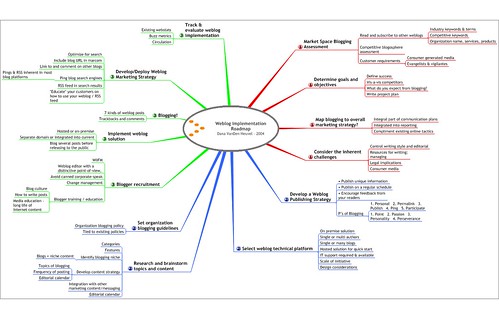

Weblog (Blog) Implementation Process Roadmap


Syndicate:

RSS RSS Feed


Posts via e-mail

Enter your email address:

Delivered by FeedBurner

Recent Posts:

Archives:

Buzz Cloud:

Recent Readers:

Tag Cloud:

Categories: