March 16, 2010

Where Did All the CEO Bloggers Go?

CEO blogs used to be all the rage within the business blogging community. Remember when we’d hear blog consultants gush about CEOs who dared to blog with transparency and authenticity. I rarely hear much talk about CEO bloggers anymore. Do you?

Remember Jonathan Schwartz? He was the poster child of blogging CEOs, the now former (as of February 3rd) CEO of Sun Microsystems. All you could hear was crickets on Jonathan’s blog from May of last year until finally Jonathan’s farewell post on January 27. Clearly he had a few things going on; Oracle was in the process of acquiring Sun. When you’re selling your company that is pretty much all that occupies your mind. I know that first-hand, as I’m happy to say my company (Netconcepts) was acquired by Covario last month.

The thing that most struck me was the name of Jonathan’s new blog. It’s titled “What I Couldn’t Say”. Hmmm. I guess transparency within a corporation only goes so far.

With the economy is in freefall, perhaps the tolerance of various boards of directors for CEO transparency has lessened? Or it could be simply that CEOs are just too busy and blogging isn’t such a priority, now that “blog” isn’t Word of the Year anymore.

Tony Hsieh, CEO of Zappos, is another CEO blogger who was acquired and who we don’t hear from any longer in the blogosphere. His last post was July of last year, and that wasn’t so much of a blog post as it was a copy of a letter that was sent to all the Zappos employees announcing the acquisition by Amazon. Before that, Tony last posted in January 2009.

I’m guilty too. My own “CEO blog” hasn’t seen any activity in over a month — no posts since Covario acquired us. But the reason for my ‘radio silence’ has nothing to do with the acquirer. I may no longer be a President/CEO, but I am still encouraged to keep blogging. The reason I don’t blog frequently is the same one as last year (when I was only posting a few times a month at best): I’m preoccupied running around speaking at conferences all over the U.S., writing for magazines, etc.

Then there are the corporate blogs where the CEO occasionally chimes in with his/her own post. My acquirer, Covario, fits into that group with its “Actionable Insights” blog. Trinity Road, an etailer of religious products like first communion dresses and rosaries, has a corporate blog, but you rarely if ever hear from the CEO on it.

Then there are the CEO blogs where you wonder if it’s actually the CEO who’s blogging because it’s so polished. Steve Spangler the science toys e-tailer, I think fits into that category. If you look at the posts on Steve’s blog you’ll see a gradual evolution to a style that is more and more polished.

Chris Baggott, CEO of the Compendium Blogware, has one of the best CEO blogs out there, in my opinion. It’s full of valuable content, it’s not overly polished, his personality really shines through, and he blogs regularly. It figures though. If any CEO would have that kind of a CEO blog, it would be the CEO of a business blogging software company!

Is Blogging Recession Proof?

There are two groups of people who apparently make hay during  a recession: journalists and Web marketers.

I’m not sure if this recession is different than previous ones, or if I’m just more aware this time around, but it seems to me that every business magazine and marketer is talking up the recession.

Business magazines run cover stories like “You Can Beat the Bad Economy.” (BusinessWeek Small Biz). Marketers talk about how to sell, market or profit from a recession in ezines, blogs, teleclasses and seminars. (I should know, I’m talking to a fellow marketer about doing a teleseminar on this very subject.)

There is one truism to a recession: market more. Yes, while everyone runs for cover, this is the time for you to ramp up your sales and marketing efforts.  One of the most cost-effective ways businesses can do this is through a blog. And, as every one else scales back on marketing, it makes your life so much easier.

Even with falling advertising costs, your blog still costs less; basically a few dollars a month in hosting fees. And, with a falling economy, there’s plenty of topics to discuss. A quick search of Technorati includes such posts as:

Hmm…maybe that last one hints that even bloggers aren’t immune to the recession…especially those who are reliant on Google Adsense to make a profit.

Blog carnivals - a link building secret weapon

One thing which has been alluded to briefly here on BusinessBlogConsulting.com in a couple previous posts is blog carnivals — a relatively untapped opportunity for blog marketing and link building.

It was fellow Business Blog Consulting contributor Toby Bloomberg who first turned me on to blog carnivals. For those who aren’t aware of what a blog carnival is, it is a traveling column on a particular subject matter that is passed on from blog to blog, each blogger selecting a topic in that subject matter and including relevant resources accompanied by their own commentary about those resources. For example, there might be a blog carnival on nonprofit marketing and indeed there is. The members of the blog carnival rotate in and out, kind of like a column rotates. Here is an example post from a nonprofit marketing blog carnival.

Why should you care about blog carnivals? In short, because it’s a great way to grow your link popularity and thus your search rankings, and because it’ll also gain you visibility in the blogosphere amongst bloggers. This can be accomplished in two ways:

  1. First, by hosting a blog carnival, you garner links you wouldn’t otherwise have garnered from the other blog carnival hosts as well as other bloggers who follow that blog carnival (assuming of course your posts are of some value!).
  2. Second, even if you don’t join a blog carnival, you can submit your own posts to the current host for consideration in the next carnival post. For instance, in the example carnival post above on nonprofit marketing (which focused on “Creating and developing online communities through Web 2.0″), imagine if you had written a post on “How Nonprofits Can Use MySpace” and then gotten that post included in that week’s edition of the carnival — and all it would have taken is reaching out to the host via email to get on their radar.

Check out BlogCarnival.com, a directory of blog carnivals, to see if a blog carnival already exists for your industry or topic of interest.

Do we have to join every social network?

This might be a question just for us social media consultants, but I think it is more generally applicable: do we need to sign up for every new social network that comes along so that we can reserve our names thereon?

This came up because I just signed up and joined friendfeed.com (and yes, the obligatory link: You can find me on friendfeed.com as DaveTaylor) partially because I was curious about it, but also because I received email from a colleague that included the comment sign up now to get good user names.

But do we really need to do this?

What’s your opinion, fellow blog and social media consultant?

Tweeting IAB Annual Meeting

Posted by: Rick E. Bruner of ExecutiveSummary.com on 02/25/08

So first let me dispense with the obligatory acknowledgment that I’m sorry I haven’t blogged here in ages. I have wanted to often, but one thing and another…

On thing I’ve wanted to write about is Twitter. I’m hooked.  So far, I’ve seen precious few Tweets (as I gather its adherents call themselves) use it especially well for business communication. Mostly people complaining about being stuck in airports. Like the rest of us might find that interesting. One who does a good job keeping the posts interesting and on topic is Steve Rubel, not surprisingly.

Another shout out I’ve meant to give is the IAB’s new blog, the IABlog, under the stewardship of the IAB’s new, compelling leader, Randall Rothenberg, who also has his own blog. I’ve gotten to know Randall a bit in the past several months, and he’s a fun guy, a great intellect (excellent panel moderator), a strong leader for the IAB and really interested demonstrating the new directions of online media with initiatives like the IABlog.

When you click through to the blog, you’ll notice a photo of yours truly serenading the original IAB chairman Rich LeFurgy.  The uke is my new hobby for the past year-plus. Soon I’ll have to do a round-up of the many photos like this that already exist of me playing the uke at industry cocktail parties on blogs around the web.

The real point of this post, though, is that I’m currently at the IAB’s Annual Meeting, Ecosystem 2.0, in Phoenix, AZ. So far, it’s one of the most exciting conferences I’ve ever attended, really. Attendee list is who’s who of the industry. As I type this (blazing fast free wifi in the conference hall; see, they get it!), Randall is interviewing Susan Decker, president of Yahoo! and Jerry Yang, CEO/founder of Yahoo! You can see the other speakers yourself here, but they are consistent with these two.

Steve Rubel is here and we’re both giving running commentary on Twitter, plus the IABlog is providing updates, too. Keep your fingers crossed that they’ll post videos of the content. Wenda Millard’s speech last night, accepting the mantel as new chairperson of the IAB, was really great. I’ll post the link of the transcript or video if it’s made available.

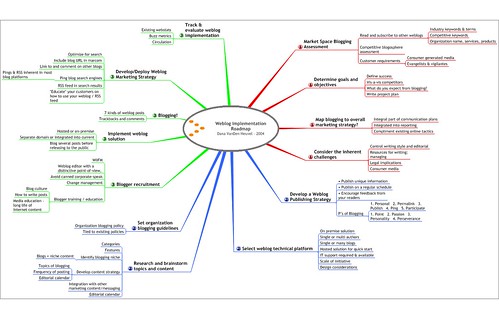
The Process of Starting a Corporate Blog

Posted by: Dana VanDen Heuvel of Made for Marketing on 02/25/08

Do you really need a process for starting a blog? Well, not if you’re a small, one-person business and you’re the only person to answer to. However, if yours is a multi-million (or billion) dollar enterprise that needs multiple layers of approval, then the following first in a three-part series on the process of setting up a corporate blog will benefit you.

This comes from a post at MarketingProfs, so here are the highlights. For the full post and original material, read on over here.

There are three phases to the corporate blog process. 1) Investigate, 2) Create, 3) Activate. This post deals only with the investgate phase, which follows these steps:
1. Determine Goals for Your Corporate Blog
You need to to determine why you’re doing this, get baseline measurements in place and create a vision for success. See the mindmap below for more detail.

2. Assess Your Market for Blog Viability
Not every company should blog. You need to understand what kind of conversation is taking place in your market and if you can easily enter the conversation with your blog strategy. You also need to look internally to make sure that this fits with your corporate culture.

3. Map to Overall Marketing/Communications Strategy
This is critical. The blog should not be an appendage or bolt-on to your marketing. If you’re going to do it right, it needs to be integrated into the rest of your messaging and conversation.

4. Risk Profile Assessment
Ask yourself a few questions to determine how ready you are to engage in the market conversation. You’ll have sooner or later, but here are a few things to look out for before you leap.
- Have you ever personally used social media and what’s your comfort level?
- What is your company’s tolerance for risk (e.g., initiating new or untested marketing tactics, launching bold corporate initiatives, etc.)?
- How does your company normally react to negative commentary from the media?

For more, read the MarketingProfs post: What’s the Process for Starting a Corporate Blog? How Long Does It Take? [Part 1 of 3].

Weblog (Blog) Implementation Process Roadmap


Syndicate:

RSS RSS Feed


Posts via e-mail

Enter your email address:

Delivered by FeedBurner

Recent Posts:

Archives:

Buzz Cloud:

Recent Readers:

Tag Cloud:

Categories: