March 17, 2010

Where Did All the CEO Bloggers Go?

CEO blogs used to be all the rage within the business blogging community. Remember when we’d hear blog consultants gush about CEOs who dared to blog with transparency and authenticity. I rarely hear much talk about CEO bloggers anymore. Do you?

Remember Jonathan Schwartz? He was the poster child of blogging CEOs, the now former (as of February 3rd) CEO of Sun Microsystems. All you could hear was crickets on Jonathan’s blog from May of last year until finally Jonathan’s farewell post on January 27. Clearly he had a few things going on; Oracle was in the process of acquiring Sun. When you’re selling your company that is pretty much all that occupies your mind. I know that first-hand, as I’m happy to say my company (Netconcepts) was acquired by Covario last month.

The thing that most struck me was the name of Jonathan’s new blog. It’s titled “What I Couldn’t Say”. Hmmm. I guess transparency within a corporation only goes so far.

With the economy is in freefall, perhaps the tolerance of various boards of directors for CEO transparency has lessened? Or it could be simply that CEOs are just too busy and blogging isn’t such a priority, now that “blog” isn’t Word of the Year anymore.

Tony Hsieh, CEO of Zappos, is another CEO blogger who was acquired and who we don’t hear from any longer in the blogosphere. His last post was July of last year, and that wasn’t so much of a blog post as it was a copy of a letter that was sent to all the Zappos employees announcing the acquisition by Amazon. Before that, Tony last posted in January 2009.

I’m guilty too. My own “CEO blog” hasn’t seen any activity in over a month — no posts since Covario acquired us. But the reason for my ‘radio silence’ has nothing to do with the acquirer. I may no longer be a President/CEO, but I am still encouraged to keep blogging. The reason I don’t blog frequently is the same one as last year (when I was only posting a few times a month at best): I’m preoccupied running around speaking at conferences all over the U.S., writing for magazines, etc.

Then there are the corporate blogs where the CEO occasionally chimes in with his/her own post. My acquirer, Covario, fits into that group with its “Actionable Insights” blog. Trinity Road, an etailer of religious products like first communion dresses and rosaries, has a corporate blog, but you rarely if ever hear from the CEO on it.

Then there are the CEO blogs where you wonder if it’s actually the CEO who’s blogging because it’s so polished. Steve Spangler the science toys e-tailer, I think fits into that category. If you look at the posts on Steve’s blog you’ll see a gradual evolution to a style that is more and more polished.

Chris Baggott, CEO of the Compendium Blogware, has one of the best CEO blogs out there, in my opinion. It’s full of valuable content, it’s not overly polished, his personality really shines through, and he blogs regularly. It figures though. If any CEO would have that kind of a CEO blog, it would be the CEO of a business blogging software company!

How Interactive is Your Blog? Measure It!

One of the coolest things about business blogging is the social interaction and community that is built when readers leave meaningful comments. Like a good story, a post elicits a response from the reader. As your community develops, the value of your brand increases. But this warm and fuzzy feeling that people get about your brand as they interact with you on your blog can be hard to measure and quantify. That’s where blog interaction metrics come in.

Building a blog to one or more interaction metrics can help you focus on what’s important - brand engagement.

Do you measure a successful post by the number of readers, bookmarks added to del.ic.ious, diggs, comments, number or quality of backlinks, or a combination of all the above? Some metrics have a place in your blog marketing scorecard, like number of comments. And some do not, like number of trackbacks (unless you like counting spammers — and that you could do all day!). Because the last thing you need is just more data for the sake of data.

Avinash Kaushik came up with some really nifty blog success metrics that really resonate with me. I bet they’ll resonate with you too. They are:

  • Raw author contribution (posts per month and words per post)
  • Audience growth (onsite & offsite, visitors and unique visitors)
  • “Conversion” rate (comments per post)
  • Citations (blog inlinks, Technorati rank)
  • Ripple Index (# of unique blogs linking to your blog)
  • Cost (time, hardware/software technology, opportunity cost
  • Benefit / ROI (comparative vs. direct vs. “non-traditional” vs. unquantifiable)

As you start measuring the above and then gauging the success of what you’re doing on your blog based on these metrics, you can tie your activities back to something more meaningful than just the “hits” you’re generating.

If you want to learn more about metrics, I encourage you to watch the archived recording of a “Website Metrics and ROI” webinar that Avinash and I presented last year. No registration required. Just click and watch (or download). It’s 100 minutes of the two of us talking about our favorite metrics — not just for blogging, but also email marketing, web marketing, search marketing, and more. And if you just want to scan over our Powerpoint slides before you invest 100 minutes of your time (and I don’t blame you — time is precious!), here’s the PPT file. Enjoy!
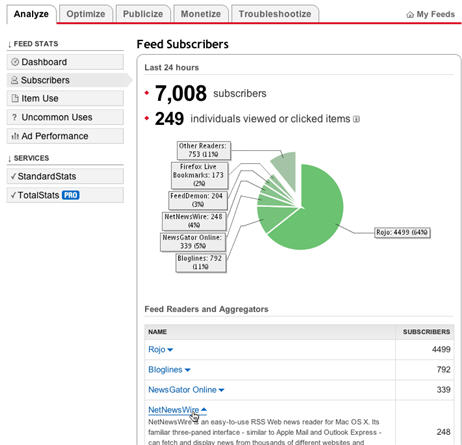
FeedBurner Blog Metrics

What blog metrics do you value most? How do your readers interact with you? Do you have any particular reporting tools you recommend? Your interactivity is welcome and invited.

 

Syndicate:

RSS RSS Feed


Posts via e-mail

Enter your email address:

Delivered by FeedBurner

Recent Posts:

Archives:

Buzz Cloud:

Recent Readers:

Tag Cloud:

Categories: